Article
Top 10 Best Internet Providers for Speed & Reliability in 2026
Find the best internet service provider for your home. Our experts compared fiber, cable, and DSL providers to help you get the fastest speeds at the best price.

Whether you’re streaming 4K movies, gaming competitively, or working from home, choosing the right internet provider makes all the difference. With options ranging from lightning-fast fiber to budget-friendly cable and new 5G wireless technology, there’s never been more choice.
Our team analyzed pricing, tested real-world speeds, evaluated reliability, and compared coverage across all major providers. Here are the best internet service providers for every need and budget in 2026.
Quick Comparison
| Provider | Best For | Price | Rating |
|---|---|---|---|
| 1. Google Fiber | Best Overall | $70/month | ★4.9/5 |
| 2. AT&T Fiber | Best Fiber Value | $45/month | ★4.8/5 |
| 3. Verizon Fios | Best for Reliability | $49.99/month | ★4.8/5 |
| 4. Xfinity | Best Cable Coverage | $40/month | ★4.5/5 |
| 5. Spectrum | Best No-Contract Option | $30/month | ★4.4/5 |
| 6. Cox | Best for Bundles | $50/month | ★4.3/5 |
| 7. Optimum | Best for Streaming | $40/month | ★4.2/5 |
| 8. Frontier | Best Budget Fiber | $29.99/month | ★4.1/5 |
| 9. Ziply Fiber | Best Regional Provider | $20/month | ★4/5 |
| 10. T-Mobile Home Internet | Best 5G Home Internet | $50/month | ★3.9/5 |
Our Top Picks in Detail

Google Fiber
Google Fiber delivers the gold standard for internet service with blazing-fast symmetrical speeds, transparent pricing, and unlimited data. Their fiber-optic network is incredibly reliable, though availability remains limited to select metropolitan areas.
Pros
- ✓Incredibly fast symmetrical speeds up to 8 Gbps
- ✓No price hikes or hidden fees
- ✓Unlimited data on all plans
- ✓Excellent customer service ratings
- ✓No contracts required
Cons
- ✗Very limited availability
- ✗Not available in rural areas
- ✗Expanding slowly to new markets

AT&T Fiber
AT&T Fiber offers some of the most affordable fiber internet plans starting at just $45/month for 100 Mbps. With extensive coverage across the southern and western U.S., it's the best choice for budget-conscious users who want fiber's reliability.
Pros
- ✓Affordable entry-level fiber plans
- ✓Wide fiber availability in 21 states
- ✓No annual contracts on fiber plans
- ✓Free installation available
- ✓99.9% network reliability
Cons
- ✗Price increases after 12 months on some plans
- ✗Equipment rental fees apply
- ✗Customer service can be inconsistent

Verizon Fios
Verizon Fios sets the standard for reliability with its 100% fiber-optic network. Price lock guarantees of up to 4 years protect you from surprise increases, and their symmetrical speeds are perfect for remote work and streaming.
Pros
- ✓Exceptional reliability and uptime
- ✓2-4 year price lock guarantees available
- ✓Symmetrical upload/download speeds
- ✓Unlimited data included
- ✓Excellent customer satisfaction scores
Cons
- ✗Limited to northeastern states
- ✗$99 installation fee
- ✗Higher prices than some competitors

Xfinity
Xfinity is America's largest cable internet provider, offering impressive speeds and widespread availability. While not as fast as fiber for uploads, it's a solid choice for most households with extensive coverage where fiber isn't available.
Pros
- ✓Available in 41 states
- ✓Fast cable speeds up to 2 Gbps
- ✓Equipment included with internet plans
- ✓Flexible contract options (1 or 5 year guarantees)
- ✓Good value for cable internet
Cons
- ✗Price increases $20 after promo period
- ✗1.2 TB data cap on most plans
- ✗Upload speeds slower than fiber

Spectrum
Spectrum offers commitment-free cable internet with unlimited data and no contracts. Their straightforward pricing and included modem make getting started easy, though you'll want to watch for price increases after the first year.
Pros
- ✓No annual contracts ever
- ✓Unlimited data on all plans
- ✓No early termination fees
- ✓Free modem included
- ✓Widespread availability across 42 states
Cons
- ✗Prices increase after 12 months
- ✗Upload speeds limited compared to fiber
- ✗Customer service reputation varies

Cox
Cox excels at bundle packages combining internet, TV, and phone services. Their Panoramic WiFi system provides excellent whole-home coverage, and the Elite Gamer add-on optimizes connections for competitive gaming.
Pros
- ✓Excellent bundle deals with TV and phone
- ✓Both fiber and cable options available
- ✓Elite Gamer service for low-latency gaming
- ✓Panoramic WiFi with whole-home coverage
- ✓24/7 technical support
Cons
- ✗Steep price increases after 24 months
- ✗Data caps on most plans
- ✗Installation fees can be high

Optimum
Optimum's fiber and cable networks deliver exceptional streaming performance with unlimited data. Their top-tier fiber plans rival Google Fiber's speeds, making them ideal for households with multiple 4K TVs and heavy streaming usage.
Pros
- ✓Lightning-fast speeds up to 8 Gbps on fiber
- ✓Unlimited data included
- ✓Strong performance for 4K/8K streaming
- ✓No annual contracts
- ✓Free Smart WiFi 6 router
Cons
- ✗Limited to Northeast corridor
- ✗Fiber availability varies by location
- ✗Price increases after promotional period

Frontier
Frontier offers some of the cheapest fiber internet available, starting at just $29.99/month for 200 Mbps. They're aggressively expanding their fiber network, making high-speed internet more accessible and affordable.
Pros
- ✓Most affordable fiber plans
- ✓No contracts or early termination fees
- ✓Unlimited data on all fiber plans
- ✓Free router included
- ✓Expanding fiber network rapidly
Cons
- ✗Fiber not available everywhere they serve
- ✗DSL service is being phased out
- ✗Customer service inconsistent during expansion
Ziply Fiber
Ziply Fiber is transforming internet access in the Pacific Northwest with rock-bottom prices and blazing speeds. Their community-focused approach and commitment to rural areas make them a standout regional provider.
Pros
- ✓Industry's lowest starting price at $20/month
- ✓Multi-gig speeds up to 10 Gbps available
- ✓Strong local customer service
- ✓No data caps or contracts
- ✓Improving rural connectivity
Cons
- ✗Only available in OR, WA, ID, MT
- ✗Newer company with limited track record
- ✗Network still expanding

T-Mobile Home Internet
T-Mobile Home Internet leverages 5G cellular technology to deliver internet without cables or installation. It's perfect for renters and rural customers who can't get traditional wired internet, though speeds depend heavily on local tower capacity.
Pros
- ✓No installation or equipment fees
- ✓Fixed price - never increases
- ✓No contracts or credit checks
- ✓Works where cable/fiber unavailable
- ✓Unlimited data included
Cons
- ✗Speeds vary significantly by location
- ✗Performance affected by network congestion
- ✗Not suitable for heavy upload needs
Understanding Internet Types
Fiber Internet
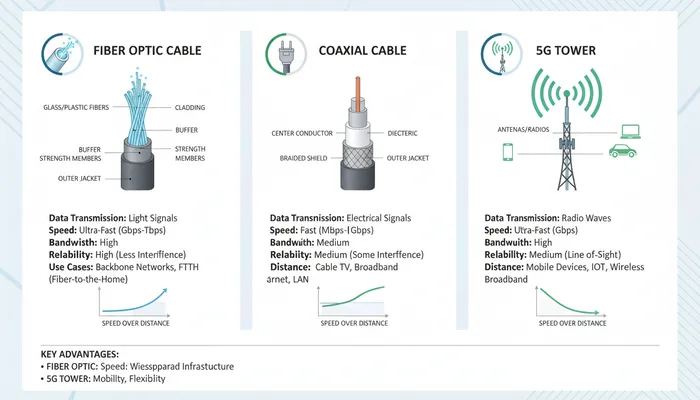
Fiber-optic service delivers the fastest and most reliable internet available. Using light signals through glass cables, fiber provides:
- Symmetrical speeds: Upload speeds match download speeds (crucial for video calls and cloud backup)
- Low latency: Excellent for gaming and real-time applications
- No interference: Weather and electrical noise don’t affect performance
- Future-proof: Capable of multi-gigabit speeds
Pricing: $20-$300/month depending on speed tier. Available to about 50% of U.S. households.
Cable Internet
Cable internet uses the same coaxial cables as cable TV. It offers:
- Fast downloads: Speeds from 100 Mbps to 2 Gbps
- Wide availability: Reaches most urban and suburban areas
- Shared connection: Speeds may dip during peak evening hours
- Asymmetrical: Download speeds much faster than uploads
Pricing: $30-$100/month. Good balance of speed and cost for most users.
DSL Internet
DSL uses existing telephone lines but is being phased out by most providers:
- Slower speeds: Typically 5-100 Mbps
- Distance dependent: Speed drops the farther you are from the provider’s office
- Most affordable: Plans from $20-$50/month
- Legacy technology: AT&T and others no longer accepting new DSL customers
Best for: Rural areas where nothing else is available, light browsing only.
5G Home Internet
Wireless internet using cellular towers eliminates the need for cables:
- No installation: Just plug in and go
- Variable speeds: 50-300 Mbps typical, depends on tower proximity
- Network dependent: Performance varies with local congestion
- Unlimited data: Most providers don’t cap usage
Pricing: $50-$70/month fixed. Great for renters and underserved areas.
How We Evaluate Internet Providers
Our testing methodology examines every aspect of the internet service experience:
Speed Testing
We measure real-world performance across different times:
- Download speeds: Testing during peak and off-peak hours
- Upload speeds: Critical for video calls and cloud services
- Latency: Ping times for gaming and conferencing
- Consistency: How stable speeds remain throughout the day
Reliability Analysis
We track uptime and connection stability:
- Network outage frequency and duration
- Weather impact on service
- Peak hour performance degradation
- Customer satisfaction with reliability
Value Assessment
We compare pricing structures:
- Promotional vs. regular pricing
- Hidden fees and equipment costs
- Data caps and overage charges
- Contract requirements and cancellation fees
Coverage Verification
We analyze geographic availability:
- States and cities served
- Rural vs. urban coverage
- Fiber availability within service areas
- Expansion plans and timeline
Frequently Asked Questions
What internet speed do I actually need?
For basic browsing and email, 25-50 Mbps is sufficient. Streaming 4K video needs 25 Mbps per device. Remote work with video calls requires 50-100 Mbps. Gaming performs best with 100+ Mbps and low latency. Households with multiple users should add speeds together and add 25% buffer.
Is fiber internet worth the extra cost?
Fiber offers symmetrical upload/download speeds, lower latency, and better reliability than cable. If you work from home, game competitively, or frequently upload large files, fiber’s superior upload speeds justify the cost. For casual browsing and streaming, cable may suffice.
Why do internet prices increase after the first year?
Most providers offer promotional pricing to attract new customers. After 12-24 months, rates increase to standard pricing. Ask about price lock guarantees—some providers like Verizon Fios offer 2-4 year price protection.
What’s the difference between download and upload speed?
Download speed affects streaming, browsing, and downloading files. Upload speed matters for video calls, cloud backup, and livestreaming. Fiber provides equal speeds; cable typically offers much slower uploads (10:1 ratio).
Do I need to rent a modem from my provider?
Many providers include equipment free (Spectrum, AT&T Fiber) while others charge $10-15/month. Buying your own DOCSIS 3.1 cable modem costs $100-200 and pays for itself in 6-12 months. For fiber and 5G services, you typically must use the provider’s equipment.
What are data caps and should I worry about them?
Data caps limit monthly usage (commonly 1-1.25 TB). Streaming 4K video uses about 7 GB/hour, so a 1 TB cap allows roughly 140 hours of 4K streaming. Heavy users should choose unlimited plans or pay $30-50/month for unlimited add-ons.
Can I get internet without a phone line or cable TV?
Yes, most providers offer standalone internet without bundles. In fact, internet-only plans are often the best value. Fiber and 5G home internet never require phone lines. Cable internet uses different technology than TV despite sharing wires.
How do I switch internet providers?
Choose your new provider and installation date first. Most services can install without canceling your old service initially. Once new service works, cancel the old one. Return equipment within the specified timeframe to avoid charges. Check for early termination fees before switching.