Article
Best First-Time Homebuyer Loans & Programs in 2026
Discover the best first-time homebuyer loans and assistance programs of 2026. Compare FHA, VA, USDA, conventional loans and down payment assistance from top lenders to find the perfect financing for your first home purchase.

Buying your first home is one of life’s biggest financial milestones, but saving for a large down payment can feel impossible. Fortunately, numerous loan programs and assistance options exist specifically for first-time homebuyers in 2026.
Our team analyzed federal programs, conventional loans, and lender-specific assistance to identify the best financing options for first-time buyers. Here are the 10 best first-time homebuyer loans and programs to help you achieve homeownership.
Quick Comparison
| Program | Best For | Min. Down | Rating |
|---|---|---|---|
| 1. FHA Loans | Best Overall for First-Time Buyers | 1.75% upfront MIP + monthly | ★4.8/5 |
| 2. VA Loans | Best for Veterans & Service Members | 2.15%-3.3% funding fee (waived for disabled) | ★4.9/5 |
| 3. USDA Loans | Best for Rural & Suburban Buyers | 1% upfront + 0.35% annual fee | ★4.6/5 |
| 4. Conventional 97 Loans | Best for Good Credit Borrowers | PMI until 20% equity | ★4.5/5 |
| 5. Rocket Mortgage ONE+ | Best for 1% Down Payment | Standard conventional fees | ★4.6/5 |
| 6. Guild Mortgage 1% Down | Best for Minimal Savings | Standard conventional fees | ★4.5/5 |
| 7. State Housing Finance Agency Programs | Best for Down Payment Assistance | Varies by program | ★4.7/5 |
| 8. Wells Fargo Dream.Plan.Home | Best Bank Assistance Program | Reduced with credit | ★4.3/5 |
| 9. Good Neighbor Next Door | Best for Public Service Workers | Standard loan fees | ★4.4/5 |
| 10. HomePath Ready Buyer | Best for Foreclosure Purchases | Reduced closing costs | ★4.1/5 |
Our Top Picks in Detail

FHA Loans
FHA loans are the #1 loan type in America for first-time homebuyers, requiring just 3.5% down with credit scores as low as 580. Backed by the Federal Housing Administration, these loans offer the perfect combination of low down payment, flexible credit requirements, and widespread lender availability.
Pros
- ✓Only 3.5% down payment required
- ✓Credit scores as low as 580 accepted
- ✓Debt-to-income ratios up to 43-57%
- ✓Available through thousands of lenders
- ✓Gift funds allowed for down payment
- ✓Most popular first-time buyer loan in America
Cons
- ✗Mortgage insurance required for life of loan
- ✗1.75% upfront mortgage insurance premium
- ✗Loan limits may be restrictive in expensive areas

VA Loans
VA loans offer unbeatable terms for eligible veterans and service members with 100% financing, no mortgage insurance, and competitive rates. The Department of Veterans Affairs guarantees these loans, making homeownership accessible for those who served our country.
Pros
- ✓0% down payment - 100% financing available
- ✓No monthly mortgage insurance required
- ✓Competitive interest rates
- ✓No minimum credit score requirement
- ✓Funding fee waived for disabled veterans
- ✓Assumable loans with VA approval
Cons
- ✗Only for veterans, service members, and spouses
- ✗Property must meet VA standards
- ✗Upfront funding fee (2.15%-3.3% of loan)

USDA Loans
USDA loans provide 0% down financing for homes in eligible rural and suburban areas, serving low- to moderate-income buyers. With below-market rates and lower fees than FHA, these government-backed loans make homeownership affordable outside major metropolitan areas.
Pros
- ✓0% down payment required
- ✓Below-market interest rates
- ✓Lower mortgage insurance than FHA
- ✓Income limits favor moderate earners
- ✓Gift funds accepted
- ✓No loan limits (based on income)
Cons
- ✗Property must be in USDA-eligible rural area
- ✗Income limits apply (varies by location)
- ✗Limited to primary residences only
Conventional 97 Loans
Conventional 97 loans from Fannie Mae and Freddie Mac require just 3% down while offering removable PMI and higher loan limits than FHA. These are ideal for first-time buyers with good credit who want to avoid permanent mortgage insurance.
Pros
- ✓Only 3% down payment required
- ✓PMI removable at 20% equity
- ✓Higher loan limits than FHA
- ✓Most popular mortgage type overall
- ✓Lower mortgage insurance than FHA
- ✓No upfront mortgage insurance premium
Cons
- ✗Requires 620+ credit score
- ✗Stricter debt-to-income requirements
- ✗Less forgiving of credit issues
Rocket Mortgage ONE+
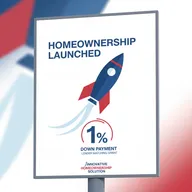
Rocket Mortgage's ONE+ program requires just 1% down from the buyer while Rocket contributes an additional 2% grant, achieving the 3% minimum for conventional financing. Combined with their tech-forward platform and customer service, it's an innovative solution for cash-strapped buyers.
Pros
- ✓Only 1% down from borrower required
- ✓Rocket provides additional 2% grant
- ✓Total 3% down payment achieved
- ✓Fast online application process
- ✓Above-average customer satisfaction
- ✓RentRewards for additional closing credits
Cons
- ✗Higher rates than standard conventional
- ✗Income and location restrictions may apply
- ✗Must qualify for conventional loan

Guild Mortgage 1% Down
Guild Mortgage's 1% Down Program mirrors Rocket's approach but adds the flexibility of 350+ branch locations nationwide. With second-highest customer satisfaction ratings and partnerships offering up to 40% down payment assistance through shared appreciation, Guild excels at creative financing.
Pros
- ✓Only 1% down from borrower
- ✓Guild contributes remaining 2% (up to $5,000)
- ✓12th-largest lender in nation
- ✓#2 customer satisfaction (J.D. Power 2026)
- ✓350+ branch locations
- ✓Shared appreciation financing up to 40%
Cons
- ✗Not available in New York State
- ✗Program availability varies by location
- ✗May have income restrictions

State Housing Finance Agency Programs
Every U.S. state operates a Housing Finance Agency offering down payment and closing cost assistance through grants, zero-interest loans, and deferred payment programs. These can be layered with FHA, VA, or conventional loans to dramatically reduce upfront costs.
Pros
- ✓Grants and forgivable loans available
- ✓No repayment on 'silent seconds' until sale
- ✓Combined with FHA, VA, or conventional loans
- ✓CalHFA offers deferred payment assistance
- ✓NYC HomeFirst: up to $100,000 assistance
- ✓Maryland Partner Match: up to $2,500
Cons
- ✗Eligibility varies widely by state
- ✗Income limits typically apply
- ✗May require homebuyer education courses

Wells Fargo Dream.Plan.Home
Wells Fargo's Dream.Plan.Home program provides up to $5,000 toward closing costs for eligible first-time buyers purchasing in targeted areas. Combined with their 3% down conventional options and relationship discounts, it's a solid choice for existing bank customers.
Pros
- ✓Up to $5,000 closing cost credit
- ✓Applies to one-time closing costs
- ✓Available in eligible census tracts
- ✓Relationship discounts for bank customers
- ✓3% down conventional options
- ✓Nationwide branch network
Cons
- ✗Geography restrictions on assistance
- ✗Must be in eligible low-to-moderate income area
- ✗Rates higher than online competitors

Good Neighbor Next Door
The Good Neighbor Next Door program offers an incredible 50% discount on HUD-owned homes for law enforcement, firefighters, EMTs, and pre-K through 12th-grade teachers. In exchange, you commit to living in the property for three years, helping revitalize designated communities.
Pros
- ✓50% discount off list price
- ✓For law enforcement, firefighters, EMTs, teachers
- ✓HUD foreclosed properties
- ✓Massive savings on purchase price
- ✓Helps revitalize communities
- ✓Can use FHA financing
Cons
- ✗Must live in property for 36 months
- ✗Limited to revitalization areas
- ✗Property selection limited to HUD inventory
HomePath Ready Buyer
Fannie Mae's HomePath ReadyBuyer program provides 3% closing cost assistance when purchasing a Fannie Mae-owned foreclosure. After completing a required online homebuyer education course, you gain access to discounted properties with reduced closing costs.
Pros
- ✓3% closing cost assistance from Fannie Mae
- ✓Applies to foreclosed properties
- ✓Online homebuyer education required
- ✓No monthly PMI with 20% down
- ✓Access to foreclosure inventory
- ✓Competitive conventional rates
Cons
- ✗Limited to Fannie Mae foreclosures
- ✗Must complete education course
- ✗Property selection limited
How We Evaluate First-Time Homebuyer Programs

Our expert team uses a comprehensive methodology to evaluate first-time homebuyer programs. Here’s what we consider:
Down Payment Requirements
We prioritize accessibility:
- Minimum down payment: 0% to 3.5% programs
- Down payment assistance: Grants, gifts, and lender contributions
- Total cash needed: Down payment plus closing costs
- Gift fund policies: Whether family assistance is accepted
Credit Requirements
We evaluate borrower-friendliness:
- Minimum credit scores: From no minimum (VA) to 620+ (conventional)
- Credit history: How many years of credit needed
- Credit issues: Forgiveness for past problems
- Alternative data: Rent and utility payment consideration
Interest Rates and Costs
We analyze affordability:
- APR competitiveness: How rates compare to market
- Mortgage insurance: Upfront and monthly costs
- Closing costs: Total fees and available assistance
- Long-term costs: Total interest over loan life
Eligibility and Availability
We consider accessibility:
- Geographic restrictions: Where programs are available
- Income limits: Maximum household income requirements
- Property restrictions: Eligible home types and locations
- Occupancy requirements: How long you must live there
Understanding First-Time Homebuyer Status
Who Qualifies as a First-Time Buyer?
You’re typically considered a first-time homebuyer if you:
- Have never owned a home before, OR
- Haven’t owned a home in the past 3 years, OR
- Are a divorced spouse who jointly owned with ex-spouse in past 3 years
Required Education Courses
Many programs require homebuyer education:
- HUD-approved courses: Available online and in-person
- Topics covered: Budgeting, mortgage types, home maintenance
- Certificates: Required for some assistance programs
- Duration: Typically 6-8 hours, can be completed online
Maximizing Your First-Time Buyer Benefits
Layering Multiple Programs
You can often combine programs:
- FHA + State HFA: FHA loan with state down payment assistance
- Conventional + Employer: 3% down with workplace assistance
- VA + State: VA loan with state-specific veteran benefits
- USDA + Local: USDA financing with county assistance
State and Local Assistance
Beyond federal programs, explore:
- State Housing Finance Agencies: All 50 states offer programs
- County programs: Local down payment assistance
- City initiatives: Municipal first-time buyer programs
- Employer programs: Workplace homebuyer assistance
Frequently Asked Questions
What is the easiest first-time homebuyer loan to get?
FHA loans are typically the easiest to qualify for, requiring just 3.5% down and credit scores as low as 580. For eligible veterans, VA loans are even easier with 0% down and no minimum credit score. USDA loans also offer 0% down for rural buyers.
How much money do I need to buy my first house?
With programs like FHA (3.5% down) or Rocket/Guild 1% down options, you could buy a $300,000 home with as little as $3,000-$10,500 down. Add 2-5% for closing costs (sometimes covered by assistance programs), and you might need $15,000-$25,000 total—or even less with grants.
Can I buy a house with no down payment?
Yes! VA loans offer 0% down for eligible veterans and service members. USDA loans provide 0% down for homes in eligible rural and suburban areas. Some state programs also offer down payment assistance covering the full 3-5% required.
What credit score do I need for a first-time homebuyer loan?
It depends on the program: VA loans have no minimum; FHA requires 580 for 3.5% down (500-579 with 10% down); USDA typically requires 640+; conventional loans need 620+. Some lenders like LoanDepot accept scores as low as 520 for FHA.
Should I use FHA or conventional as a first-time buyer?
Choose FHA if you have: lower credit scores (580-619), higher debt-to-income ratio, or limited savings. Choose conventional if you have: 620+ credit score, stable income, ability to save 3-5%, and want removable PMI. Conventional often costs less long-term for qualified buyers.
What is the $15,000 first-time homebuyer grant?
Various state and local programs offer grants ranging from $2,500 to $100,000+ (NYC HomeFirst). While not all programs offer exactly $15,000, many state HFAs provide substantial assistance. Check your state Housing Finance Agency for available grants.
Do I have to pay back first-time homebuyer assistance?
It depends on the program. Some are grants (no repayment), some are forgivable loans (forgiven after you live there X years), and some are “silent seconds” (deferred until you sell, refinance, or pay off the first mortgage). Always read program terms carefully.
Can I get down payment assistance with good credit?
Yes! Many programs don’t have credit score maximums—only minimums. Rocket ONE+ and Guild 1% Down are available to anyone who qualifies for conventional financing. Some state programs do have income limits, but assistance isn’t limited to those with poor credit.
What’s the difference between FHA and VA loans?
VA requires 0% down (vs 3.5% FHA), has no mortgage insurance (vs MIP for FHA), and typically offers lower rates. However, VA is only for eligible veterans/service members while FHA is available to everyone. VA properties must meet stricter inspection standards.
How long does it take to close on a first-time homebuyer loan?
FHA and conventional loans typically close in 30-45 days. VA loans may take 40-50 days due to additional property requirements. USDA loans can take 45-60 days. Quick closers like Better Mortgage can deliver preapproval in minutes and close in 21-30 days.